Bridge Labs Logo

BRIDGE LABS

Solution

Bridge HR

Follow

LinkedinInstagramFacebookX

Resources

Insights

Use Cases

SMBsBPOsStaffing AgenciesStartupsEnterprise

© 2026 Bridge Labs. All rights reserved. | Privacy Policy | Terms and Conditions

AI Resume Screening: 6 Ways It Reduces Time-to-Hire Without Sacrificing Quality

Regine CyrilleRegine CyrilleHuman Resource19 Jun 2026
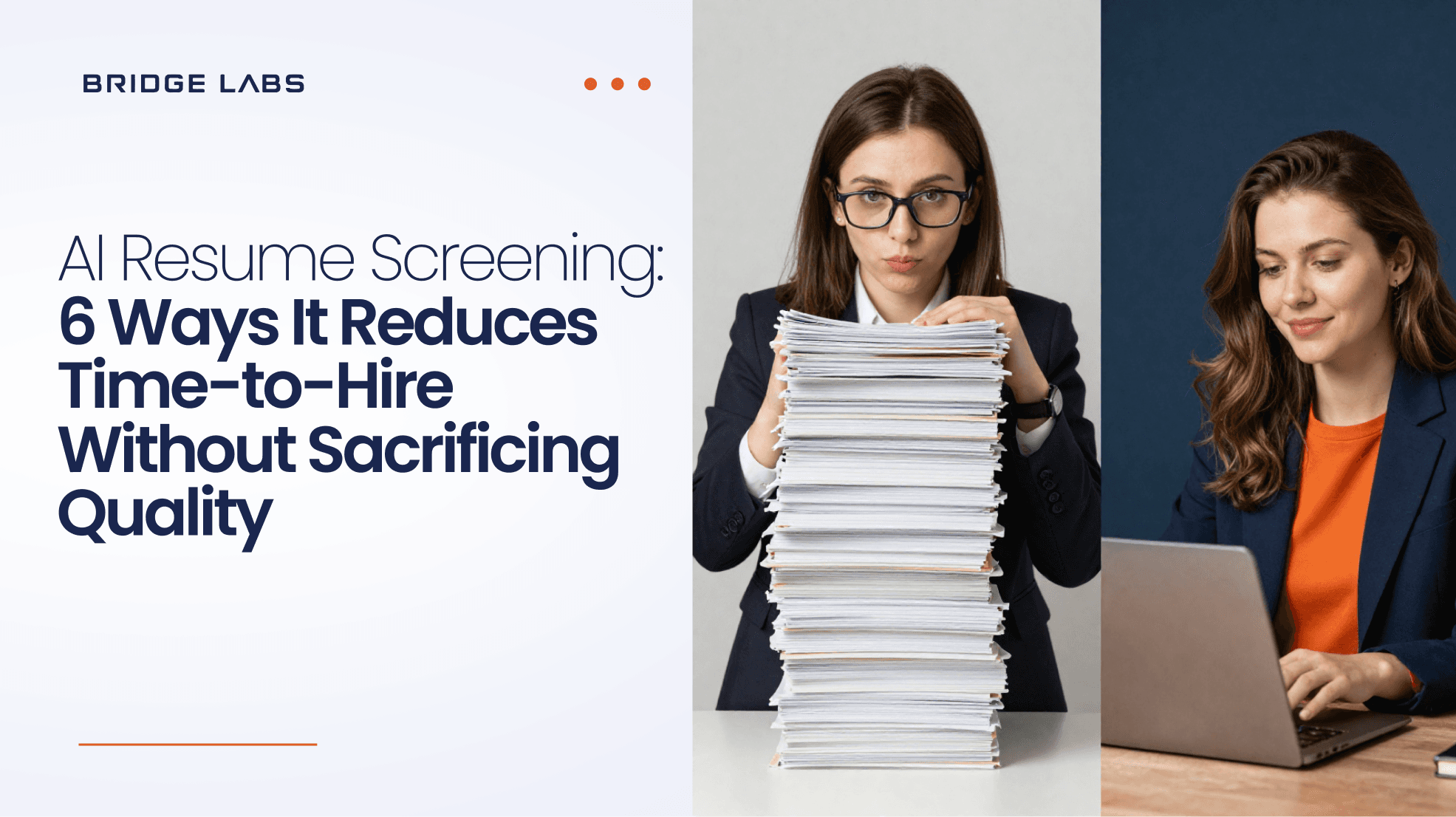
Blog Cover_AI Resume Screening_ 6 Ways It Reduces Time-to-Hire Without Sacrificing Quality

The average corporate job posting receives around 250 resumes, and recruiters spend an average of 7.4 seconds reviewing each one during the initial pass, according to a widely cited eye-tracking study by TheLadders.


At that pace, roughly 245 of those applications are being sorted by pattern recognition rather than careful evaluation.

The only question worth asking is whether that pattern recognition occurs in a recruiter's fatigued brain at the end of a long review session or within a calibrated, auditable system configured around the role's actual requirements.

AI resume screening tools promise to change that equation significantly. When implemented with clear criteria, ongoing calibration, and human oversight at every consequential decision point, they deliver on that promise.

The challenge is that "AI screening" has become a category broad enough to cover everything from basic keyword matching to machine learning models trained on years of real hiring outcomes.

Understanding exactly what a tool does and where it fits within your specific hiring process is what separates teams that see genuine ROI from those that simply introduce a new set of problems alongside the old ones.

magnific_splitscreen-stressed-recr_DBRvv1Qpcl

How AI Resume Screening Works

Before examining what AI screening can do for your hiring metrics, it helps to understand the technology underneath the marketing language.
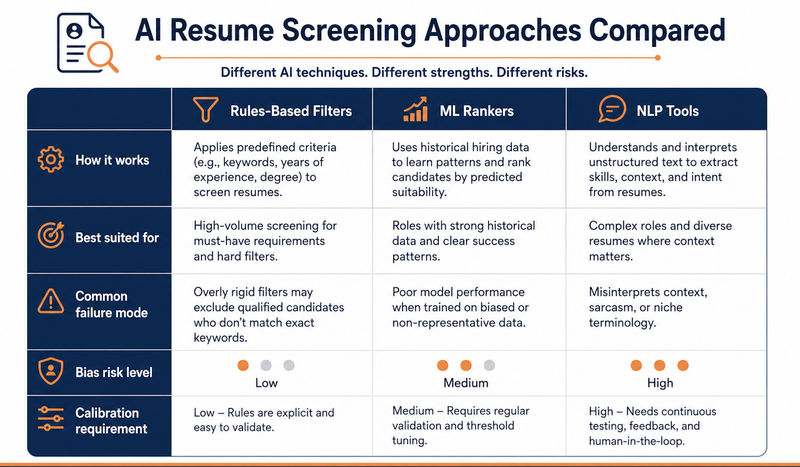
Most AI resume screening tools fall into one of three categories, each with meaningfully different strengths and failure modes.

  • Rules-based filters check each resume against a defined set of hard criteria, such as required years of experience, specific certifications, or geographic location. These tools are fast and highly predictable, but they will systematically reject qualified candidates who describe the same competency using slightly different language than what appears in your criteria list.
  • Machine learning rankers use models trained on your organization's past hiring data, or on broader industry datasets, to generate a predicted fit score for each candidate. These tools are more nuanced than keyword filters, but they can encode historical bias if your previous hiring population was not diverse or representative of the candidates you actually want to attract.
  • Natural language processing (NLP) tools read for semantic meaning rather than exact keyword matches. A candidate who wrote "led cross-functional teams" and a candidate who wrote "managed multi-department product initiatives" both surface for the same role because the model understands the underlying competency rather than the specific words used. NLP tools require more careful configuration and ongoing validation, but they are substantially more capable for complex or senior roles.

The distinction between these categories matters because each fails in a different way. Knowing which type you are using is the prerequisite for using it correctly.

AI Resume Screening Approached Compared

Latest From Our Blog

Discover fresh insights, trends, and tips on tech talent and offshore development. Stay informed with our latest updates

Subscribe to our Newsletter

Get the best insights on remote work, hiring, and engineering management in your inbox.

Explore Africa's Growing Tech Population

Explore Africa's Growing Tech Population

Workforce26 Dec 2023
4 Reasons to Hire African Software Developers

4 Reasons to Hire African Software Developers

Workforce21 Jun 2025
The Key to Hiring the Right Developer With Technical Assessments

The Key to Hiring the Right Developer With Technical Assessments

Technology07 Nov 2024
6 Best Practices for Hiring Offshore Developers: A Guide for CEOs, CTOs, and COOs

6 Best Practices for Hiring Offshore Developers: A Guide for CEOs, CTOs, and COOs

Human Resource17 Jun 2024
Bridge Labs & DevMatch: Streamlining Technical Assessments for African Software Developers

Bridge Labs & DevMatch: Streamlining Technical Assessments for African Software Developers

Human Resource25 Apr 2024
The Ultimate Guide to Agile Collaboration for High-Performing Dev Teams | 2025 Best Practices

The Ultimate Guide to Agile Collaboration for High-Performing Dev Teams | 2025 Best Practices

Workforce01 May 2025

Ready to Upgrade Your HR Tech Stack?

6 Ways AI Resume Screening Reduces Time-to-Hire

1. Eliminates the First-Pass Bottleneck

Manual first-pass screening is consistently one of the most time-intensive, low-value activities in any recruiting operation. For a role receiving 200 or more applications, a recruiter spending even five minutes per resume is committing more than 16 hours of focused review time before a single qualified candidate reaches a hiring manager. When multiple open roles are running concurrently, this bottleneck compounds quickly into hiring delays that affect business outcomes well beyond the talent team.

AI tools reduce the first-pass bottleneck to near zero. The system surfaces the top 10 to 20 percent of candidates in minutes, providing recruiters with a prioritized queue rather than an undifferentiated pile.

Data from 2026 reports, including insights compiled from SHRM and Deloitte, indicate that AI-assisted candidate screening reduces total time-to-hire by up to 50% without compromising the quality of hires or retention. Furthermore, adopting automated screening workflows accelerates the recruitment pipeline by focusing human effort on high-value engagement rather than manual sorting.
For more data on this trend, visit RecruitAI Suite
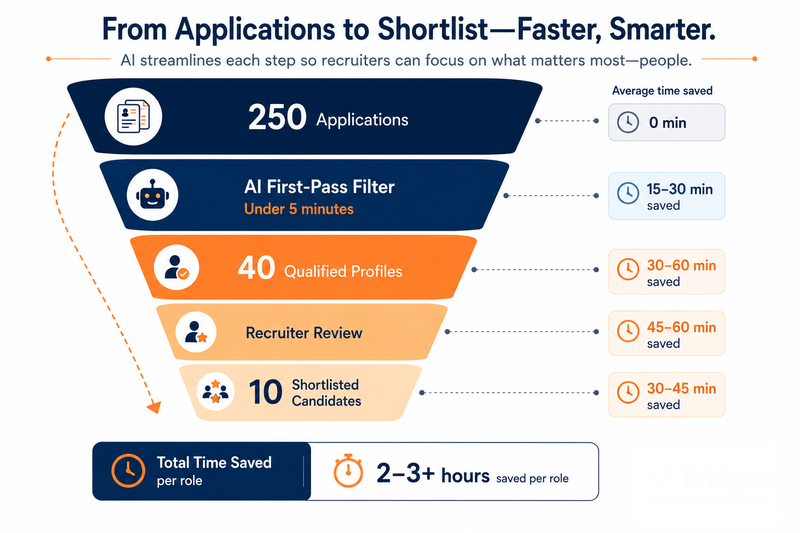

Animated funnel diagram showing the application-to-shortlist flow


2. Applies Criteria Consistently Across Every Application

Human reviewers are inconsistent, and the research on why is unambiguous. Cognitive load, time pressure, and unconscious pattern recognition all affect judgment in ways that individual reviewers rarely notice.
Research published in Organizational Behavior and Human Decision Processes found that candidates reviewed later in a batch session are rated significantly lower than equally qualified candidates reviewed earlier, even by the same experienced recruiter reviewing the same criteria.

AI systems apply identical criteria to application number one and application number two hundred and forty-seven, regardless of the time, how many resumes have already been reviewed, or how closely the candidate's background matches the reviewer's own career path.

This consistency does not eliminate bias from the hiring process. Bias can still enter through the criteria themselves, through flawed model training data, or through downstream decisions. What consistency does eliminate is one of the most pervasive and least auditable sources of variance in candidate evaluation. Audit trails and model validation are still essential, but consistency in the application of criteria is itself a meaningful quality improvement over purely manual review at scale.

3. Surfaces Non-Traditional Candidates That Human Screeners Miss

One of the more counterintuitive advantages of well-configured AI screening is its ability to surface strong candidates from non-traditional backgrounds that a human screener might deprioritize due to habit or pattern recognition.

This includes career changers with directly transferable skill sets, candidates from smaller or less recognizable companies operating in the same industry, and candidates without specific degree credentials applying for roles that do not genuinely require them.

This benefit only materializes when the tool is configured around demonstrated competencies and outcomes rather than credential proxies.

An NLP tool asked to evaluate what a candidate actually did, rather than where they worked or what their job title was, can find strong matches that keyword-based filters would never surface. The result is a broader, more competitive shortlist and a stronger pipeline of candidates who would have been invisible to the previous process.

4. Frees Recruiters for High-Judgment Work

Every hour a recruiter spends manually sorting through unqualified applications is an hour not spent building relationships with strong candidates, briefing hiring managers on what the market actually looks like, or improving the interview experience for people who are already in the process.

These higher-value activities are the ones that directly affect offer acceptance rates, candidate quality, and the speed at which critical roles get filled.

AI screening creates the capacity for this shift by handling volume at the top of the funnel. Teams that have implemented AI-assisted screening consistently report that recruiter time reallocates toward candidate engagement, sourcing strategy, and hiring manager alignment rather than administrative triage.
The quality of those conversations improves because recruiters arrive prepared and focused, rather than already depleted from hours of manual review.
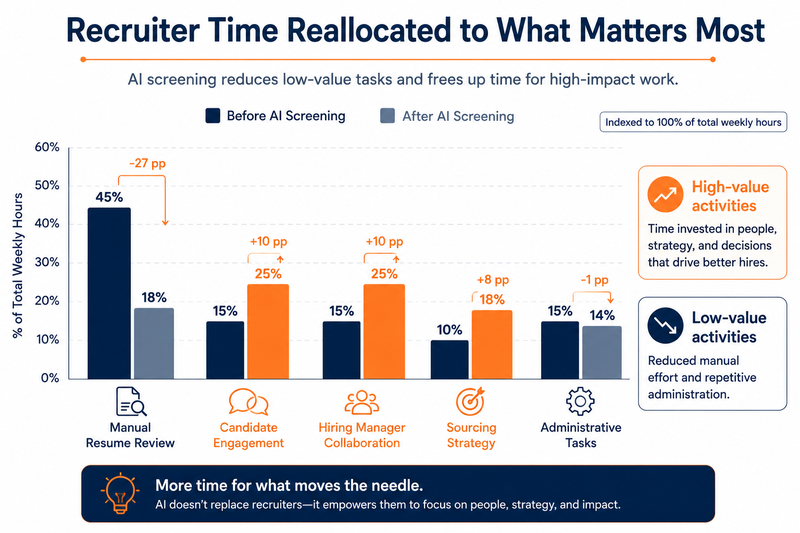
Reallocation of recruiter time with AI


5. Enables Structured, Repeatable Calibration Across Roles

One of the persistent challenges in recruiting is that hiring criteria for the same role often drift among hiring managers, teams, and over time as business priorities shift.

AI screening creates a documented, editable set of criteria for each role that can be reviewed, tested against actual hire performance, and refined over successive hiring cycles. This turns screening from an informal, subjective judgment call into a structured process with a built-in feedback loop.

When a candidate is successfully hired, the candidate's characteristics can be used to validate or adjust the model's weighting. When a hire underperforms or churns quickly, the signal can be traced back to the screening criteria, identifying where the misalignment originated.

Over time, this feedback loop produces progressively sharper shortlists. Manual screening processes rarely generate this kind of structured learning because the criteria exist primarily in individual reviewers' heads rather than in a system that can be interrogated and improved.

6. Reduces Bias Exposure at the Highest-Volume Decision Point

The first-pass screening stage is the highest-volume decision point in any hiring funnel, which means it is also the stage where bias has the greatest cumulative effect on outcomes.

When a human reviewer is processing 200 applications, even a subtle pattern of deprioritizing candidates with unfamiliar names, unconventional career paths, or non-traditional educational backgrounds can exclude a significant portion of the qualified candidate pool before any structured evaluation has taken place.

AI systems, when properly audited and maintained, apply criteria without being influenced by name, perceived gender, age, or other demographic signals that should not affect a hiring decision.

This does not mean AI is bias-free. Models trained on historical data can encode past biases at scale, which is why bias auditing and ongoing validation are non-negotiable for any responsible deployment. The important distinction is that AI bias is auditable, adjustable, and systematically testable in ways that individual human judgment at volume is not.

Where AI Screening Goes Wrong

The most expensive mistake organizations make with AI resume screening is treating it as a fire-and-forget system. A model trained on hiring data from 18 months ago may be operating on outdated signals if the role requirements, the competitive talent landscape, or the team composition have shifted since training. Regular calibration against actual hiring performance is what causes the tool to improve over time rather than silently degrade while producing a false sense of confidence.

The second most common failure is the use of keyword-based tools for roles that require creative, adaptive, or interpersonal skills. These are precisely the roles where strong candidates describe their work in varied and personal language. Keyword matching systematically disadvantages the candidates most likely to bring distinctive value to those positions, and it often does so invisibly, since the filtered-out profiles never appear in any report.

The third mistake is eliminating human review entirely from final shortlist decisions. AI screening should compress the top of the funnel and sharpen the shortlist. It should not replace the human judgment required to make a consequential decision about who joins your organization. The legal and ethical responsibility for hiring outcomes remains with the employer, regardless of the tools used in the process.

The Bottom Line

AI resume screening works best as a precision tool configured around the specific requirements of each role and calibrated continuously against actual hiring outcomes.
The time savings are real, well-documented, and compound meaningfully at volume.

However, they only materialize when you understand what the model is optimizing for, maintain structured human oversight at decision points, and approach the system as something that requires ongoing management rather than a one-time configuration.

The teams that get the most from AI screening are the ones that use it to handle volume at the top of the funnel while redirecting recruiter expertise toward the work that actually requires human skill: engaging candidates thoughtfully, aligning with hiring managers on what the business genuinely needs, and making nuanced judgment calls on the candidates whose profiles fall outside the clearest patterns.

FAQs

What does AI resume screening actually do?

AI resume screening automates the first pass of the hiring funnel by using artificial intelligence, including rules-based filters, machine learning models, or natural language processing, to evaluate and rank job applications against the defined requirements of a specific role. The output is a prioritized shortlist for recruiter review, which compresses the time spent on manual screening without removing human judgment from the process at consequential decision points.

How accurate is AI resume screening?

Accuracy depends heavily on the type of AI used, how well it has been configured for the specific role, and how consistently it is calibrated against actual hire performance over time. NLP-based tools tend to outperform keyword-matching systems because they evaluate semantic meaning rather than exact word matches. All tools degrade in accuracy without regular calibration, so ongoing maintenance is a requirement rather than an optional enhancement.

Can AI resume screening introduce bias into hiring?

Yes, it can, and this risk is well-documented. AI screening tools can encode and amplify existing bias if they are trained on historical hiring data that reflects past exclusionary patterns. This is precisely why bias audits, third-party validation, and detailed audit trails are non-negotiable components of any responsible deployment. Consistency in the application criteria does not automatically produce fairness. It shifts the location where bias can enter the process rather than eliminating it entirely, which is why the criteria themselves and the model's training data require scrutiny.

What separates AI screening from basic keyword matching?

Keyword matching scans resumes for specific terms and phrases that appear in the job description, rejecting any application that uses different language to describe the same competency. AI screening, particularly NLP-based tools, reads for underlying meaning and can recognize that "managed a team of five engineers" and "led a cross-functional engineering group" both signal leadership experience, even though the words used are entirely different. This distinction matters significantly for complex, senior, or creative roles where strong candidates describe their work in varied and specific language.

Is AI resume screening legal?

AI resume screening is legal in most jurisdictions, but regulation in this area has expanded significantly through 2024 and 2025. Several US states and cities, including Illinois, Maryland, and New York City, have passed laws requiring disclosure to candidates when AI tools are used in hiring, along with bias auditing requirements and candidate opt-out provisions. Compliance requirements vary by location and continue to evolve, so legal counsel should verify applicable obligations before deploying any AI screening tool in your hiring process.

AI ScreeningBridgeHrResume Screening
Hiring process